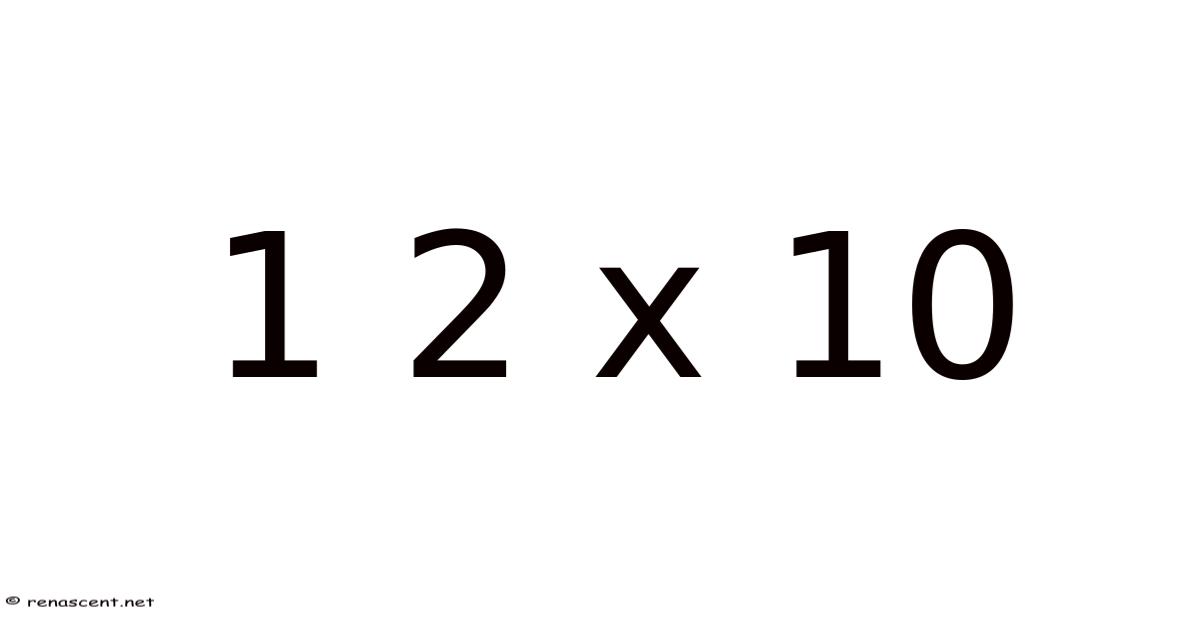
Decoding 1, 2 x 10: Exploring the Multifaceted Meaning and Applications
The seemingly simple expression "1, 2 x 10" can represent a surprising array of meanings and applications, depending on the context. Think about it: it's not just a basic multiplication problem; it's a gateway to understanding fundamental mathematical principles, scientific notations, and even the nuances of communication and interpretation. This article delves deep into the various interpretations and implications of "1, 2 x 10," exploring its relevance across different disciplines. We will unravel the ambiguity, reveal the hidden depths, and showcase its multifaceted applications.
Introduction: The Ambiguity and the Challenge
At first glance, "1, 2 x 10" appears straightforward. Does the comma separate distinct numbers, creating two separate expressions (1, 2 and 10), or is it a formatting choice within a single numerical representation? The answer lies in understanding the context. One might immediately interpret it as a multiplication problem: (1 + 2) x 10 = 30. On the flip side, the comma introduces ambiguity. This ambiguity highlights the crucial role of clear communication and proper notation in any field involving numerical data.
Interpretation 1: Simple Arithmetic (1 + 2) x 10
The most common and straightforward interpretation treats "1, 2" as a combined numerical expression where the comma acts as a separator between the digits that should be added before multiplication. Following the order of operations (PEMDAS/BODMAS), we first perform the addition (1 + 2 = 3) and then the multiplication (3 x 10 = 30). This interpretation is intuitive and likely the first approach most individuals would take. And this is a fundamental concept in arithmetic, suitable for elementary-level mathematics and used extensively in daily life. Here's one way to look at it: calculating the total cost of 10 items costing $1 and $2 each.
Key takeaway: This interpretation emphasizes the importance of order of operations and the fundamental principles of addition and multiplication.
Interpretation 2: Scientific Notation and Significant Figures
"1, 2 x 10" could also represent a number expressed in scientific notation, where '1,2' denotes the significand (or mantissa) and '10' represents the exponent of 10. Even so, the comma here is unconventional. In standard scientific notation, the decimal point (.Which means ) is used. Which means, "1.2 x 10<sup>1</sup>" would be the correct representation. Here's the thing — this highlights a common pitfall in scientific communication: the importance of adhering to established conventions to avoid ambiguity. Plus, using a comma instead of a decimal point creates confusion and deviates from accepted scientific notation standards. Scientific notation is crucial in expressing extremely large or small numbers efficiently in scientific contexts, from astronomical distances to the size of atoms.
Key takeaway: Proper use of decimal points and adhering to established scientific notation conventions are critical for clear and unambiguous scientific communication It's one of those things that adds up..
Interpretation 3: Data Representation and Lists
In some programming contexts or data representation schemes, "1, 2 x 10" could represent a list or array. This interpretation depends entirely on the data structure and the conventions used within a particular system or programming language. Also, this might lead to a sequence like {1, 2, 1, 2, 1, 2, 1, 2, 1, 2}, repeated ten times. The "x 10" might indicate a repetition or replication of the elements {1, 2}. It highlights the diversity of ways numbers can be used and manipulated beyond basic arithmetic.
You'll probably want to bookmark this section.
Key takeaway: The context in which the number appears dramatically alters its meaning. This underscores the importance of considering the overall system or framework when interpreting numerical data Simple, but easy to overlook. That alone is useful..
Interpretation 4: Vector Representation in Physics and Engineering
Within the domains of physics and engineering, "1, 2 x 10" might symbolically represent a vector. But the interpretation would depend entirely on the defined vector space and its conventions. Vector mathematics plays a vital role in expressing physical quantities like force, velocity, and acceleration. Although highly unconventional, it could be interpreted in a similar manner as in data representation, potentially implying ten repetitions of a 2-dimensional vector (1, 2). Misinterpreting the notation could lead to significant errors in physical calculations and simulations.
Key takeaway: Domain-specific conventions strongly influence interpretation. A clear understanding of the underlying context and notations is crucial for accuracy in physics and engineering applications The details matter here..
Mathematical Exploration: Beyond the Initial Interpretations
Let's explore the mathematical possibilities further. We can dissect the expression into various mathematical components and operations:
-
Prime Factorization: The numbers 1, 2, and 10 can be broken down into their prime factors: 1 (itself), 2 (itself), and 10 (2 x 5). Understanding prime factorization is foundational in number theory and cryptography.
-
Modular Arithmetic: Exploring the expression within the context of modular arithmetic (working with remainders after division) could reveal interesting patterns and relationships. As an example, (1 + 2) mod 10 = 3, meaning the remainder when (1+2) is divided by 10 is 3 Most people skip this — try not to..
-
Set Theory: We can consider {1, 2} as a set containing two elements, and the "x 10" could represent the Cartesian product (forming all possible ordered pairs) with another set, perhaps {1, 2, 3,...10}. This opens up the field of combinatorics and the study of sets.
-
Number Systems: The expression can be represented in various number systems, such as binary (base-2), hexadecimal (base-16), etc. Converting between number systems is essential in computer science and digital electronics.
FAQ: Addressing Common Queries
Q: What is the standard mathematical interpretation of "1, 2 x 10"?
A: While not standard notation, the most likely interpretation is (1 + 2) x 10 = 30, assuming the comma separates parts of a single numerical expression to be summed before multiplication That alone is useful..
Q: Why is the comma ambiguous in this context?
A: Commas are used in different ways in mathematics and computer science. They might denote separation within a list, decimal separators in some regions, or simply be a formatting artifact. The lack of standard usage creates ambiguity.
Q: How can I avoid such ambiguity in my own writing or programming?
A: Use clear and unambiguous notation. In mathematics, prefer decimal points for fractions instead of commas. In programming, stick to the established conventions of your chosen language and data structures. Provide comments to clarify your intentions.
Q: What are some practical applications of understanding this kind of ambiguous expression?
A: Being able to handle ambiguous notation is crucial for data processing, scientific interpretation, programming, and general problem-solving. Identifying and resolving ambiguity is a valuable skill.
Conclusion: The Importance of Context and Clear Communication
The seemingly simple expression "1, 2 x 10" serves as a compelling example of how crucial context and clear communication are when handling numerical expressions. By examining this expression from multiple perspectives, we've gained a broader appreciation for the subtlety and complexity hidden within seemingly straightforward mathematical statements. Now, ambiguity in notation can lead to errors and misunderstandings, especially in fields where precision is critical. Its multiple interpretations highlight the need for rigorous adherence to established mathematical and scientific conventions. Day to day, strip it back and you get this: the need for clarity, precision, and a deep understanding of the context in which numerical expressions are used. This knowledge isn't just useful for mathematics but is highly transferable to other fields, emphasizing the importance of unambiguous communication in any field involving data interpretation and analysis.
