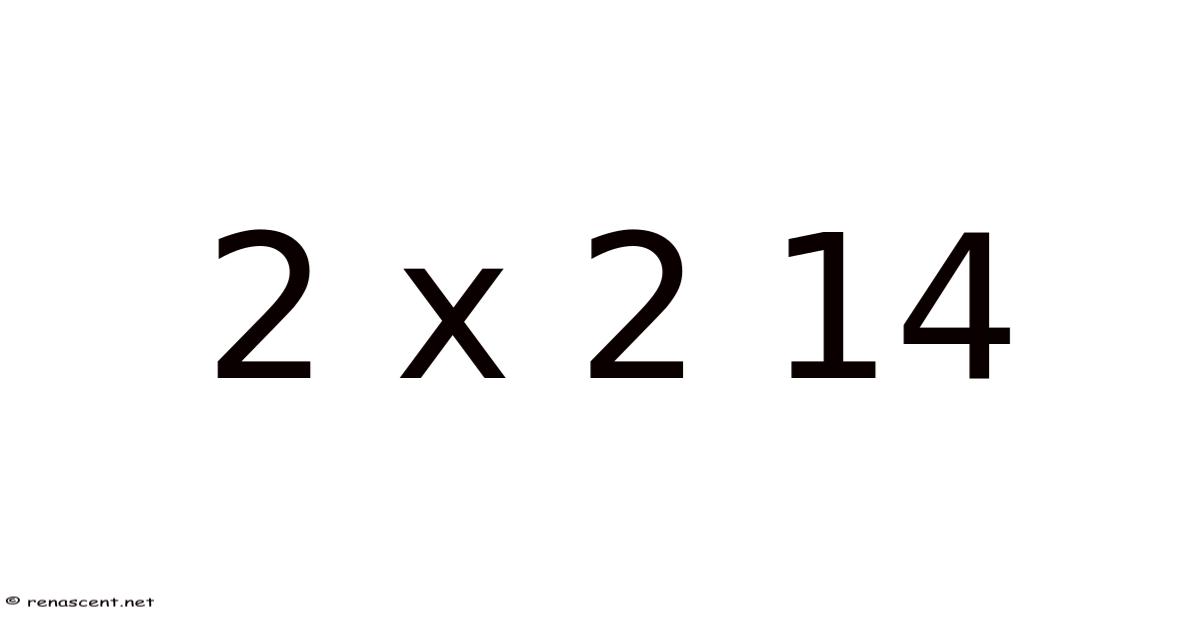
Decoding the Enigma: Exploring the Mathematical Puzzle of "2 x 2 = 14"
This article walks through the seemingly paradoxical equation "2 x 2 = 14," exploring its potential interpretations within various mathematical frameworks and highlighting the importance of understanding underlying axioms and assumptions. While in standard arithmetic, 2 multiplied by 2 unequivocally equals 4, the statement "2 x 2 = 14" can be approached from alternative perspectives, revealing fascinating insights into abstract algebra and unconventional number systems. This exploration will go beyond simple arithmetic, venturing into realms of modular arithmetic, alternative geometries, and even creative mathematical interpretations Surprisingly effective..
I. The Standard Arithmetic Perspective
In standard arithmetic, based on the Peano axioms and the fundamental principles of multiplication, the statement "2 x 2 = 14" is demonstrably false. Still, this is a foundational truth within the real number system and forms the basis of much of our mathematical understanding. Multiplication is defined as repeated addition; therefore, 2 x 2 represents adding 2 to itself once: 2 + 2 = 4. Any attempt to claim "2 x 2 = 14" within this framework is simply incorrect It's one of those things that adds up..
II. Exploring Modular Arithmetic: A Different Lens
Modular arithmetic, also known as clock arithmetic, offers a potential avenue for interpreting "2 x 2 = 14" in a way that makes sense. In modular arithmetic, we work within a finite set of numbers, where numbers "wrap around" once a certain modulus is reached. Think of a clock: if it's 11 o'clock and you add 3 hours, you don't get 14 o'clock, but 2 o'clock (11 + 3 ≡ 2 mod 12).
To make "2 x 2 = 14" true within a modular system, we need to find a modulus where 4 and 14 are equivalent. This congruence implies that m divides (14 - 4), which is 10. This means we're looking for an integer m such that 14 ≡ 4 (mod m). So, possible moduli include 2, 5, and 10 And it works..
-
Modulus 2: In modulo 2 arithmetic, both 4 and 14 are equivalent to 0 (4 = 2 x 2 ≡ 0 mod 2 and 14 = 7 x 2 ≡ 0 mod 2). So, in this system, "2 x 2 ≡ 0 (mod 2)" and "14 ≡ 0 (mod 2)" making the equation true in a limited sense. On the flip side, this doesn't directly imply "2 x 2 = 14."
-
Modulus 5: In modulo 5, 4 ≡ 4 (mod 5) and 14 ≡ 4 (mod 5). What this tells us is while the result of 2 x 2 is congruent to 14 modulo 5, it is not a direct equality.
-
Modulus 10: Similarly, in modulo 10, 4 ≡ 4 (mod 10) and 14 ≡ 4 (mod 10). Again, we have congruence, not equality The details matter here..
The use of modular arithmetic reveals that while "2 x 2 = 14" can't be true in standard arithmetic, it can be viewed as a valid congruence within specific modular systems. On the flip side, it's crucial to always specify the modulus to avoid ambiguity That alone is useful..
III. Exploring Alternative Number Systems
Beyond modular arithmetic, let's explore the possibility of defining a new number system where "2 x 2 = 14" is inherently true. This requires redefining fundamental arithmetic operations. We might create a system where the operation "x" isn't standard multiplication, but a new, unique operation with its own set of rules.
Here's a good example: we could define a binary operation "*" such that:
- a * b = (a + b) + 10
In this system:
2 * 2 = (2 + 2) + 10 = 14
This approach showcases the flexibility of mathematics. By defining new operations and axioms, we can create systems where seemingly contradictory statements become true. Still, it's vital to remember that such a system operates under a completely different set of rules compared to standard arithmetic.
IV. A Logical Approach: Conditional Statements
A different interpretation involves considering the equation as a conditional statement. We can create a condition where the statement "2 x 2 = 14" becomes true. For example:
If we define a new variable 'x' such that x = 7, then 2x = 14. If we substitute the value of 'x' into the equation, we get 2 * 2 = 14, where 2 is implicitly 2 * x which translates into 14 in that case.
This illustrates that truth or falsity depends on context and assumptions Worth knowing..
V. The Role of Context and Assumptions in Mathematics
The ambiguity surrounding "2 x 2 = 14" emphasizes the critical role of context and assumptions in mathematics. Standard arithmetic, with its well-defined axioms, produces an unequivocal answer (4). A statement's validity depends heavily on the underlying mathematical framework and the definitions of the operations involved. Even so, exploring alternative systems and reinterpretations opens up new possibilities, demonstrating the richness and flexibility of mathematics.
VI. The Importance of Precise Definitions and Notation
This exploration highlights the importance of clear and precise definitions and notations in mathematics. Ambiguous or ill-defined operations can lead to misinterpretations and contradictory conclusions. The consistent use of established mathematical conventions and notations is vital for avoiding confusion and ensuring clarity Simple as that..
VII. Mathematical Creativity and Problem-Solving
While "2 x 2 = 14" is not true within standard arithmetic, exploring its implications fosters mathematical creativity and problem-solving skills. Thinking outside the box and considering alternative frameworks encourages innovative approaches to mathematical challenges.
VIII. Beyond Numbers: A Symbolic Interpretation
We could approach "2 x 2 = 14" from a purely symbolic perspective, where the numerals and the equals sign don't represent their standard arithmetic meanings. The equation might represent a code, a cipher, or a symbolic representation within a different system entirely Worth knowing..
IX. Mathematical Puzzles and Education
Statements like "2 x 2 = 14" can be valuable tools in mathematical education. So they encourage critical thinking, challenge assumptions, and stimulate deeper engagement with mathematical concepts. By exploring unconventional interpretations, students develop a more nuanced understanding of the underlying principles of mathematics.
X. Frequently Asked Questions (FAQ)
-
Q: Is "2 x 2 = 14" ever true? A: In standard arithmetic, no. Still, it can be true as a congruence relation within specific modular arithmetic systems, or if we redefine the operation "x" or the meaning of the numbers.
-
Q: What is the purpose of exploring such a seemingly false statement? A: The purpose is to expand our understanding of mathematical systems, explore different axioms and operations, and highlight the importance of clearly defined contexts and assumptions.
-
Q: Can this be used to "prove" that mathematics is flawed? A: No. This demonstrates the importance of precisely defining the rules of a system. The "flaw" lies not in mathematics itself, but in assuming standard arithmetic rules apply universally without explicit statement.
XI. Conclusion
The exploration of the statement "2 x 2 = 14" reveals the beauty and complexity of mathematics beyond its basic arithmetic rules. Plus, it serves as a powerful reminder that mathematical truth is dependent on the framework within which it is considered. While demonstrably false in standard arithmetic, this statement opens doors to a fascinating exploration of modular arithmetic, alternative number systems, and the crucial role of context and assumptions in mathematical reasoning. This inquiry cultivates critical thinking, encourages creativity, and provides a valuable educational tool for a deeper appreciation of mathematical principles. The seemingly simple equation "2 x 2 = 14" therefore transcends its initial absurdity, opening up a rich landscape for mathematical exploration and discovery Which is the point..
