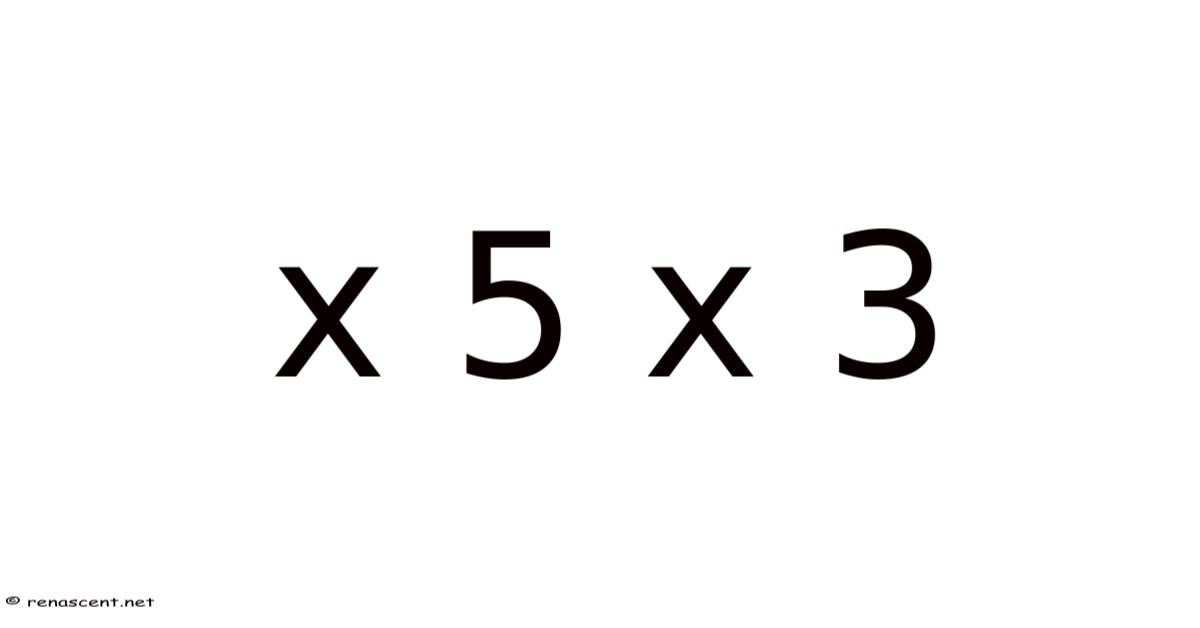
Decoding X 5 X 3: Exploring Multiplication, Arrays, and Real-World Applications
This article digs into the seemingly simple mathematical expression "x 5 x 3," unraveling its complexities and exploring its diverse applications across various fields. We'll move beyond the basic calculation to understand the underlying concepts of multiplication, array representation, and the significance of this expression in practical scenarios. This exploration will cover different interpretations, from basic arithmetic to advanced concepts, making it suitable for a wide range of readers, from elementary school students to those seeking a deeper understanding of mathematical principles.
Understanding the Basics: Multiplication as Repeated Addition
At its core, "x 5 x 3" represents a multiplication problem. Here's the thing — for example, 5 x 3 can be understood as adding 5 three times (5 + 5 + 5 = 15). Multiplication itself is a fundamental arithmetic operation, essentially a shortcut for repeated addition. The expression signifies the multiplication of 'x' by 5, and the result is then multiplied by 3. Let's assume 'x' represents a numerical value. That's why, "x 5 x 3" is equivalent to adding 'x' fifteen times It's one of those things that adds up..
If x = 2, then the expression becomes: 2 x 5 x 3 = 30. This is calculated as (2 x 5) x 3 = 10 x 3 = 30, or equivalently, 2 x (5 x 3) = 2 x 15 = 30. This illustrates the associative property of multiplication, where the grouping of factors doesn't affect the final product.
Visualizing with Arrays: A Geometric Interpretation
Understanding multiplication can be significantly enhanced through visual representation. Plus, this rectangle would have 5 rows and 3 columns. Which means the expression "x 5 x 3" can be visualized as a rectangular array. Imagine a rectangle with 'x' representing the number of items in each small square. The total number of items in the rectangle would then represent the result of the expression "x 5 x 3.
Take this: if x = 2 (representing 2 items per small square), the array would have 5 rows and 3 columns, each cell containing 2 items. Plus, the total number of items would be 30, confirming our previous calculation (2 x 5 x 3 = 30). This visual approach helps to solidify the concept of multiplication and makes it more intuitive, especially for younger learners.
Beyond the Numbers: Algebraic Representation and Variables
The use of 'x' introduces an algebraic element to the problem. This makes the expression "x 5 x 3" more versatile and applicable to a wider range of situations. We can substitute different values for 'x' to obtain different results. Even so, instead of a specific numerical value, 'x' acts as a variable, representing an unknown quantity. This simple expression serves as a building block for more complex algebraic equations and problem-solving.
Real-World Applications: Exploring Diverse Scenarios
The expression "x 5 x 3" finds its applications across various fields, providing a framework for solving practical problems. Let's consider some examples:
-
Calculating Costs: Imagine you are buying apples. Each apple costs 'x' dollars, and you want to buy 5 bags, with each bag containing 3 apples. The total cost would be "x 5 x 3" dollars. If each apple costs $1, the total cost would be $15 (1 x 5 x 3 = 15). If each apple costs $2, the total cost would be $30 (2 x 5 x 3 = 30).
-
Area Calculation: If you have a rectangular garden with a length of 5 meters and a width of 3 meters, and 'x' represents the area of each square meter (e.g., the number of plants per square meter), then "x 5 x 3" represents the total number of plants in the garden.
-
Production and Inventory: In a factory, if 'x' represents the number of units produced per hour, and the factory operates for 5 hours a day, 3 days a week, then "x 5 x 3" would calculate the total number of units produced in a week That's the whole idea..
-
Data Analysis: In a simple data set with 5 categories and 3 sub-categories within each category, and 'x' representing the number of data points in each sub-category, "x 5 x 3" helps in calculating the total number of data points.
These examples highlight the expression's utility in diverse scenarios, showcasing its relevance beyond the confines of abstract mathematics That's the part that actually makes a difference..
Expanding the Concept: Higher-Dimensional Arrays and Beyond
The visualization of "x 5 x 3" as a two-dimensional array can be extended to higher dimensions. Which means imagine a three-dimensional array representing a stack of rectangular boxes. Worth adding: if we have 'x' items in each small cube, and the stack has dimensions 5 x 3 x 2 (5 layers, 3 rows, and 2 columns), the total number of items would be calculated through a three-dimensional multiplication: x 5 x 3 x 2. This demonstrates the scalability and adaptability of this fundamental mathematical concept to more complex scenarios.
Addressing Common Misconceptions: Order of Operations (PEMDAS/BODMAS)
While the associative property of multiplication allows flexibility in grouping, you'll want to understand the order of operations in more complex expressions. Here's the thing — in the absence of parentheses or exponents, multiplication and division are performed from left to right. The acronym PEMDAS (Parentheses, Exponents, Multiplication and Division, Addition and Subtraction) or BODMAS (Brackets, Orders, Division and Multiplication, Addition and Subtraction) dictates the order in which operations should be performed. In "x 5 x 3," this doesn't affect the outcome, but in more complex expressions, following the correct order is crucial for accurate calculations Simple, but easy to overlook..
Further Exploration: Applications in Programming and Computer Science
The concept of multiplication, as exemplified by "x 5 x 3," is fundamental in computer science and programming. Operations on these structures, often involving multiplication, are essential for various algorithms and computations. Arrays and matrices, which are multi-dimensional structures, are frequently used to represent data. The efficiency of these operations impacts the performance of computer programs, highlighting the importance of a thorough understanding of the underlying mathematical principles That's the part that actually makes a difference. That's the whole idea..
Frequently Asked Questions (FAQ)
-
Q: What if 'x' is a decimal or a fraction? A: The expression "x 5 x 3" works equally well with decimal or fractional values for 'x'. The calculation remains the same; simply multiply the value of 'x' by 5, and then multiply the result by 3.
-
Q: Can 'x' be a negative number? A: Yes, 'x' can be a negative number. The result will be negative if 'x' is negative, because multiplying a negative number by a positive number results in a negative number And it works..
-
Q: How does this relate to other mathematical concepts? A: This expression is closely related to concepts like distributive property (e.g., a(b + c) = ab + ac), area calculation (as demonstrated earlier), volume calculation (in three dimensions), and more advanced concepts in algebra and calculus.
-
Q: Why is understanding this important? A: Understanding this seemingly simple expression provides a foundation for understanding more complex mathematical concepts. It helps build problem-solving skills and allows us to apply mathematical principles to real-world situations Took long enough..
Conclusion: The Power of Simplicity
The expression "x 5 x 3," despite its apparent simplicity, holds a wealth of mathematical significance. From basic arithmetic to advanced applications in algebra, geometry, computer science, and various other fields, its underlying concepts are essential for understanding and solving a wide variety of problems. The ability to visualize this expression as an array, understand the role of variables, and apply it to real-world scenarios demonstrates the power of mathematical thinking and the importance of grasping fundamental concepts. Also, by exploring this seemingly simple expression, we've unlocked a window into the broader world of mathematics and its profound impact on our daily lives. The journey from simple multiplication to its multifaceted applications showcases the beauty and utility of mathematics, encouraging further exploration and a deeper appreciation of this fundamental discipline That alone is useful..
