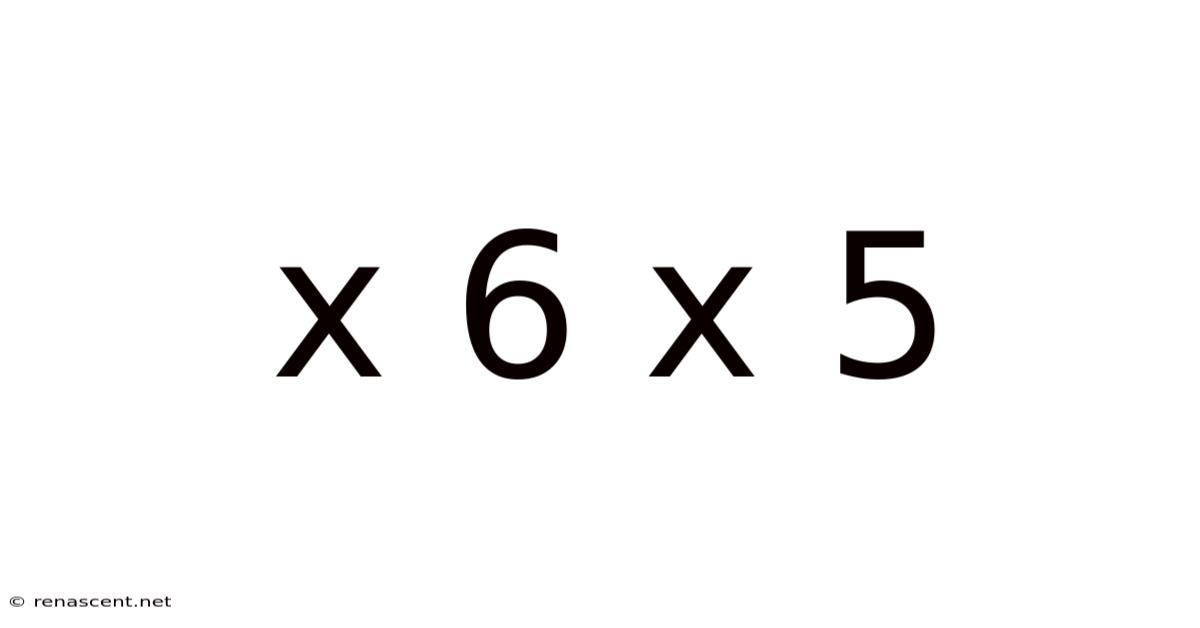
Decoding the Enigma: A Deep Dive into the Mathematical World of 6 x 5 x X
The seemingly simple expression "6 x 5 x X" might appear straightforward at first glance. On the flip side, this seemingly basic arithmetic equation opens a doorway to a surprisingly vast landscape of mathematical concepts, applications, and interpretations. This article will explore the multiple facets of this expression, delving into its fundamental arithmetic, its algebraic implications, its potential real-world applications, and addressing common questions surrounding its interpretation. Understanding 6 x 5 x X isn't just about finding a numerical answer; it's about grasping the underlying principles of mathematics and their versatility.
Understanding the Fundamentals: Basic Arithmetic
Let's begin with the most fundamental interpretation: treating "X" as an unknown variable requiring a numerical value. On the flip side, in this case, "6 x 5 x X" represents a simple multiplication problem. The first step involves solving the known multiplication: 6 multiplied by 5 equals 30. Because of this, the expression simplifies to "30 x X".
To find a definitive numerical answer, we need a value for X. Consider this: if, for example, X = 2, then the expression becomes 30 x 2 = 60. Here's the thing — if X = 10, the solution is 30 x 10 = 300. The beauty of this equation lies in its adaptability; the answer changes dynamically based on the value assigned to X. This highlights the importance of variables in mathematics – they represent unknown quantities that can take on different values depending on the context Surprisingly effective..
Algebraic Exploration: Unveiling the Power of X
Moving beyond basic arithmetic, "6 x 5 x X" allows us to explore the fundamentals of algebra. In algebra, "X" represents an unknown or a variable. This variable can represent various quantities, making algebraic equations highly versatile tools for solving problems in various fields Not complicated — just consistent. That's the whole idea..
The expression can be rewritten in a more conventional algebraic form: 30X = Y (where Y represents the final result). This equation represents a linear relationship between X and Y. This simple linear equation forms the foundation for many more complex algebraic concepts. Here's the thing — graphically, this equation would represent a straight line passing through the origin (0,0) with a slope of 30. Understanding this basic relationship is crucial for grasping more advanced algebraic manipulations and problem-solving Simple, but easy to overlook..
We can also manipulate this equation. Now, for instance, if we know the final result (Y), we can solve for X: X = Y/30. This allows us to determine the value of the unknown variable based on the outcome. This demonstrates the power of algebraic manipulation in solving for unknowns Not complicated — just consistent. Practical, not theoretical..
Real-World Applications: From Simple Calculations to Complex Models
The seemingly simple "6 x 5 x X" equation has numerous applications in diverse real-world scenarios. Let's consider a few examples:
-
Calculating Area: Imagine you're calculating the area of a rectangular prism. If the length is 6 units, the width is 5 units, and the height is represented by X units, then the volume of the prism is given by 6 x 5 x X cubic units. This equation allows us to calculate the volume given the height.
-
Cost Calculation: Consider a scenario where you are buying items. Each item costs $6, and you buy 5 items. If X represents the cost of an additional type of item, the total cost would be 6 x 5 + X dollars. This illustrates how the equation can be adapted to incorporate additional factors Small thing, real impact..
-
Production Rates: Let's say a factory produces 6 units of a product per hour, and operates for 5 hours. If X represents an additional production rate from a second machine, the total production for the day would be 6 x 5 + X units. This is a simple example of how this equation could model production rates within a larger system.
-
Scientific Modeling: While this specific equation may not be used directly in complex scientific models, the principles behind it—using variables to represent unknown quantities and performing mathematical operations to find solutions—are fundamental to all scientific modeling. Whether it's calculating the trajectory of a projectile or predicting population growth, the ability to manipulate variables and equations is essential Worth keeping that in mind..
Expanding the Possibilities: Beyond Simple Multiplication
The expression "6 x 5 x X" can be extended to incorporate more complex mathematical concepts Easy to understand, harder to ignore..
-
Exponents: The equation could be rewritten as (6 x 5)X<sup>n</sup> where 'n' represents an exponent. This introduces the concept of exponential growth or decay, which has significant applications in various fields, including finance, biology, and physics.
-
Functions: The equation can be represented as a function: f(X) = 30X. This allows for a more formal mathematical representation and enables us to explore properties of this function, such as its domain, range, and continuity.
-
Calculus: While beyond the scope of this basic analysis, the principles underlying this equation become crucial in calculus. The concept of rate of change, integral calculus, and differential equations all build upon these fundamental algebraic manipulations and the use of variables.
Frequently Asked Questions (FAQ)
Here are some frequently asked questions about the expression "6 x 5 x X":
Q: What is the importance of the variable X?
A: The variable X represents an unknown quantity. Its presence makes the equation versatile, allowing it to represent a range of situations and solve for different values depending on the context.
Q: Can X be a negative number?
A: Yes, X can be a negative number. The result of the equation will then also be negative. This is a fundamental aspect of algebra Still holds up..
Q: Can X be zero?
A: Yes, if X = 0, then the entire expression equals zero (6 x 5 x 0 = 0) No workaround needed..
Q: Can X be a fraction or decimal?
A: Yes, X can be any real number, including fractions and decimals. The result will be the product of 30 and the value of X Nothing fancy..
Q: What if we replace the multiplication with another operation?
A: Changing the operation would significantly alter the meaning and the solution. If we used addition (6 + 5 + X), or subtraction (6 - 5 - X), the outcome would be completely different and the mathematical principles involved would be different as well The details matter here. No workaround needed..
Conclusion: The Unfolding Potential of a Simple Equation
The seemingly simple equation "6 x 5 x X" serves as a gateway to a world of mathematical concepts and applications. Plus, from basic arithmetic to algebraic manipulation, and from simple real-world calculations to the foundations of advanced mathematical modeling, this equation highlights the power of variables, the versatility of mathematical operations, and the underlying principles that govern various aspects of our world. But understanding this expression is not just about finding a numerical answer; it's about grasping the fundamental concepts that underpin numerous mathematical and scientific endeavors. The more we explore this seemingly simple equation, the richer our understanding of mathematics becomes, revealing a depth and complexity that belies its initial appearance. It encourages us to delve deeper, question assumptions, and appreciate the power of mathematical thinking in solving diverse problems Less friction, more output..
